.png)
.png)

A partner blog by Lukas Fehr, Swiss Carbon Removal Platform
To reach net zero and limit the global warming to 1,5 to 2 degrees Celsius, it will not be enough to reduce emissions. Even with the most ambitious emissions reductions, some industries such as agriculture, cement, and aviation will still produce residual emissions for decades to come. Carbon dioxide removal (CDR) closes that gap by removing CO₂ directly from the atmosphere and storing it permanently, making net zero achievable and even net-negative emissions possible.
The scale of the challenge is significant: The IPCC estimates we will need to remove up to 730 billion tonnes of CO₂ by 2100, nearly 15 times of current annual global emissions. CDR is not a replacement for cutting emissions. It is a critical complement, ensuring we meet climate targets and begin correcting the pollution of the past.
What is carbon removal?
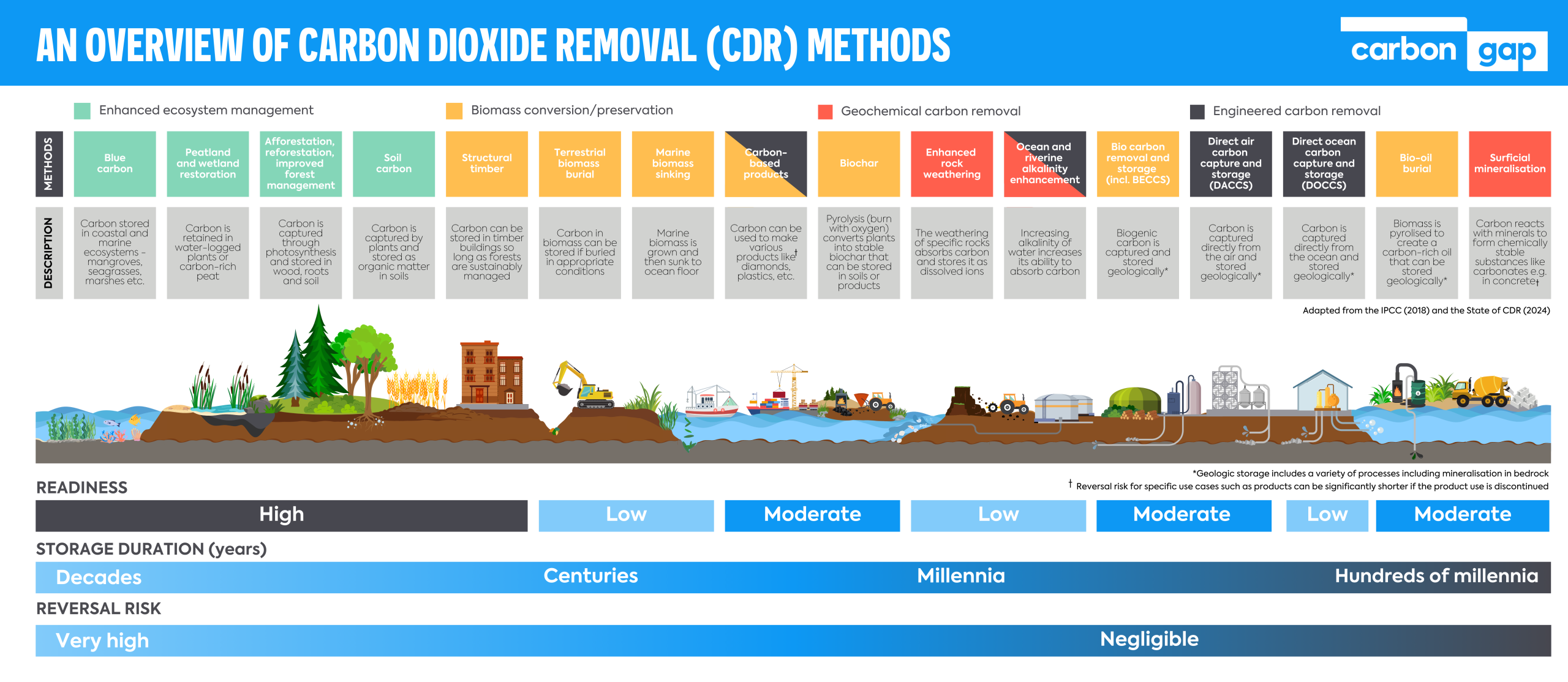
CDR involves biological, chemical, and technological methods to extract and store CO₂ over the long term. The field spans a wide range of approaches:
Conventional methods include methods with natural carbon sinks such as reforestation, wetland restoration, and soil carbon sequestration. These are proven solutions that also deliver biodiversity and ecosystem benefits but are limited in scale.
Novel methods include methods that capture CO₂ from ambient air such as direct air capture (DAC), enhanced rock weathering (ERW) or bioenergy with carbon capture and storage (BECCS) or store the carbon in cement or biomass (e.g. biochar or hydrochar).
Each method involves trade-offs in cost, scalability, and permanence. A diversified portfolio of approaches is key to achieving the scale the climate challenge demands.
Current opportunities and challenges
Scaling CDR from promising concepts to impactful projects comes with various challenges but also carries a lot of opportunities.
Financing the gap & investing in infrastructure
High upfront costs and uncertain carbon prices puts a strain on broad private investment. For CDR to become a viable industry, the price paid for a tonne of removed CO₂ must reflect its true value. The opportunity is significant: functioning carbon markets and public co-investment can unlock an entirely new green finance sector.
Regulatory gaps and policy uncertainty
CDR sits in a regulatory grey zone in most countries. Standards for measuring, reporting, and verifying carbon removal are still being developed, and questions around long-term liability remain unanswered. Countries and companies that help define these rules early will gain a lasting advantage, positioning themselves as leaders in a field that will only grow in importance.
Technology readiness and permanence
Many carbon removal technologies are still in early phases and need significant scaling. Permanence of storage must be rigorously guaranteed and verified. This challenge is also an innovation opportunity: the companies and research institutions that crack these problems will be at the frontier of one of the most consequential technology transitions of this century.
Resource conflicts and ecosystem effects
CDR competes for land, biomass, and renewable energy that are needed elsewhere. Managed well, however, these trade-offs can become synergies. Nature-based carbon removal approaches, when designed with care, can restore biodiversity, improve soil health, and strengthen ecosystems rather than strain them.
Time to act
Carbon removal is not a distant dream or a techno-fix to justify inaction. CDR is a concrete, necessary part of the climate response towards net zero and beyond, and the window to scale it in time is narrowing.The challenges are real, but they are not reasons for inaction.
Now is the time to scale the different approaches, start building the infrastructure and markets needed to achieve net zero.
Carbon removal at Climate Week Zurich
Switzerland and Europe boasts a blossoming ecosystem of actors in the field, from investors to climate techs to market makers - making Climate Week Zurich an ideal hub to move CDR forward. Climate Week Zurich featured a range of events focused on carbon removal, climate finance, and innovation, including:
General CDR
Scaling CDR
- From Pilots to Portfolios: Pioneers’ Perspectives on What's Next for CDRs (First Climate)
- Scaling carbon removal: Insights from Swiss corporate climate leaders (neustark)
- Theory vs reality: an inside look at DACCS scaling (ClimeFi, 1PointFive, NextGen CDR)
- Opportunities for Heavy-Emitting Sectors in Carbon Removal (Carbon Removal Partners)
- Insetting 101 (south pole)
CDR purchasing
- Inside NextGen CDR Buyers Club: Lessons on Carbon Removal Purchasing (NextGen CDR, South Pole)
- Reducing Risk, Time & Cost in Carbon Removal Purchasing Agreements (OSCAR: The Open Standard Carbon Removal Agreement)
- The Corporate Buyer's Guide to Article 6.2 and Durable CDR (ClimeFi)
Financing CDR
- Carbon Dioxide Removal (CDR) Finance Summit (Carbonfuture, SIX and Google)
- Carbon As an Asset Class: Bridging the Gap to Financial Markets (First Climate)
- Options in Carbon Removal (Green Fintech Network and ZHAW)
- The future of carbon markets: towards a bankable and just asset class (EY)
Nature-based CDR
- Nature on the Balance Sheet – What Does It Take? (reilo)
- Terra Dine & Dialogue (terra)
- Sinking Carbon, Seeding Growth: A Field Trip (NextGen CDR, South Pole & Stadt Zürich)
- Investable Mangroves (blueYou)
- CO₂-Removal im Schweizer Wald | Projekt vor Ort erleben (urstamm)
- Financing Nature Restoration at Scale, from Philanthropy to Capital Markets (The Rocket Foundation)
- Restore Biodiversity (My Blue Planet)
- NbS Breakfast: Showcasing the Impact of Assisted Natural Regeneration (NatureRe)
- Investing in nature restoration: aligning climate, nature and capital (NatureRe)
Engineered CDR
- From Waste to Carbon Removal: Biochar Coffee & Tea in Nature (BCHAR)
- What Does Biochar Carbon Removal Look Like in Practice? (Cula, First Climate)
- Inside Carbon Storage: A Guided Tour Underground (Recoal)
- Site visit: Permanently storing CO₂ in mineral waste streams (neustark)
- Besichtigung des Carbon Removal Kraftwerks der Bioenergie Frauenfeld
- Vom Wald ins Gebäude: CO₂ als Wert im Holzbau (Timber Carbon)
CDR Networking / Community
- Carbon & Climate Connections: Networking Apéro (Recoal)
- CDR Zurich Dinner (Carbonfuture, SIX & Carbon Removal Partners)
- ClimeFi & Partners Apero: CDR on Track
- CDR Dinner (neustark)
- Carbon removal policy apéro (carbon gap)
About the author: Lukas Fehr is co-lead of the Swiss Carbon Removal Platform, a Swiss network of over 70 members dedicated to scaling sustainable solutions to reach net zero.